


weBoost Home Complete

- Coverage: Up to 7,500 sq. ft.
- Maximum gain: 72 dB
- Network support: 4G LTE and 5G networks
SureCall Flare 3.0

- Supported signal types: Voice, text, 4G LTE, and 5G
- Coverage: Up to 2,500 sq ft with strong outside signal
- Antenna configuration: Directional outdoor antenna and one omnidirectional inside antenna
CEL-FI QUATRA EVO

- Frequency bands: 1/3/5/7/8/20/26/28/40
- Main unit dimensions: 18.1 x 11.0 x 3.5 in
- Main unit weight: 19.4 lbs (8.80 kg)
The weBoost Home Complete is our best overall home cell phone booster because its published coverage is up to 7,500 square feet, and it supports all U.S. carriers and 4G LTE and 5G networks. For a smaller home, consider the SureCall Flare 3.0, which lists coverage up to 2,500 square feet with strong outside signal. The SureCall Fusion5s 2.0 is another option to compare, with a listed maximum gain of 72 dB and support for 5G and 4G LTE service.
For the wider category, see home essentials for different households.
For a related need, compare our best meat slicer for home use.
Another focused comparison is our best light bulbs for home.
How do our recommended picks compare?
| Product | Best for | Coverage | Maximum gain | Antenna configuration |
|---|---|---|---|---|
| weBoost Home Complete | Broad household coverage | Up to 7,500 sq. ft. | 72 dB | None |
| SureCall Flare 3.0 | Smaller home setup | Up to 2,500 sq ft with strong outside signal | 72 dB | Directional outdoor; one omnidirectional inside |
| SureCall Fusion5s 2.0 | Comparing listed carrier and service support | None | +72 dB max | None |
| CEL-FI QUATRA EVO | Buyers comparing documented band support | None | None | None |
Which home cell phone booster options should you compare?
1. weBoost Home Complete Best Overall
The weBoost Home Complete is a fit for households that want a system intended to serve multiple rooms and users. Its published coverage is up to 7,500 square feet, and the product supports all U.S. carriers and 4G LTE and 5G networks. Coverage in a particular home depends on the signal available to the outdoor antenna and other site conditions. A booster amplifies available cellular signal rather than creating one where none exists. This is a substantial coverage target to consider for a larger home, rather than an automatic choice for a small space.
Best for Households seeking broad indoor coverage across multiple rooms and devices.
| Coverage | Up to 7,500 sq. ft. |
|---|---|
| Maximum gain | 72 dB |
| Network support | 4G LTE and 5G networks |
Pros
- Published coverage of up to 7,500 square feet.
- Supports all U.S. carriers and 4G LTE and 5G networks.
Cons
- Coverage depends on the signal available outside the home.
- A larger coverage system may be unnecessary for a small home or one trouble spot.
Buy if You want a system with documented support for all U.S. carriers and a stated coverage area up to 7,500 square feet.
Skip if You need service where there is no usable outside cellular signal, or a broad-coverage system is more than your home requires.
Sources: Product source
2. SureCall Flare 3.0 Alternative Pick
The SureCall Flare 3.0 is an option for a home where a directional outdoor antenna can be aimed toward a useful signal source. It pairs that antenna with one omnidirectional inside antenna and supports voice, text, 4G LTE, and 5G. Published coverage is up to 2,500 square feet with strong outside signal; weaker outside signal can mean less indoor coverage. Its published coverage makes it a possible fit for a smaller home, rather than the broadest-coverage choice here.
Best for Smaller homes that need a straightforward directional-antenna setup.
| Supported signal types | Voice, text, 4G LTE, and 5G |
|---|---|
| Coverage | Up to 2,500 sq ft with strong outside signal |
| Antenna configuration | Directional outdoor antenna and one omnidirectional inside antenna |
Pros
- Supports voice, text, 4G LTE, and 5G.
- The kit includes a directional outdoor antenna and one omnidirectional inside antenna.
- Published coverage is up to 2,500 square feet with strong outside signal.
Cons
- Coverage can be smaller when outside signal is weak.
- The outdoor antenna must be installed and aimed.
Buy if You want documented support for voice, text, 4G LTE, and 5G with a directional outdoor antenna.
Skip if You need a documented coverage estimate beyond 2,500 square feet with strong outside signal, or do not want a directional outdoor antenna.
Sources: Product source
3. SureCall Fusion5s 2.0 Another Option
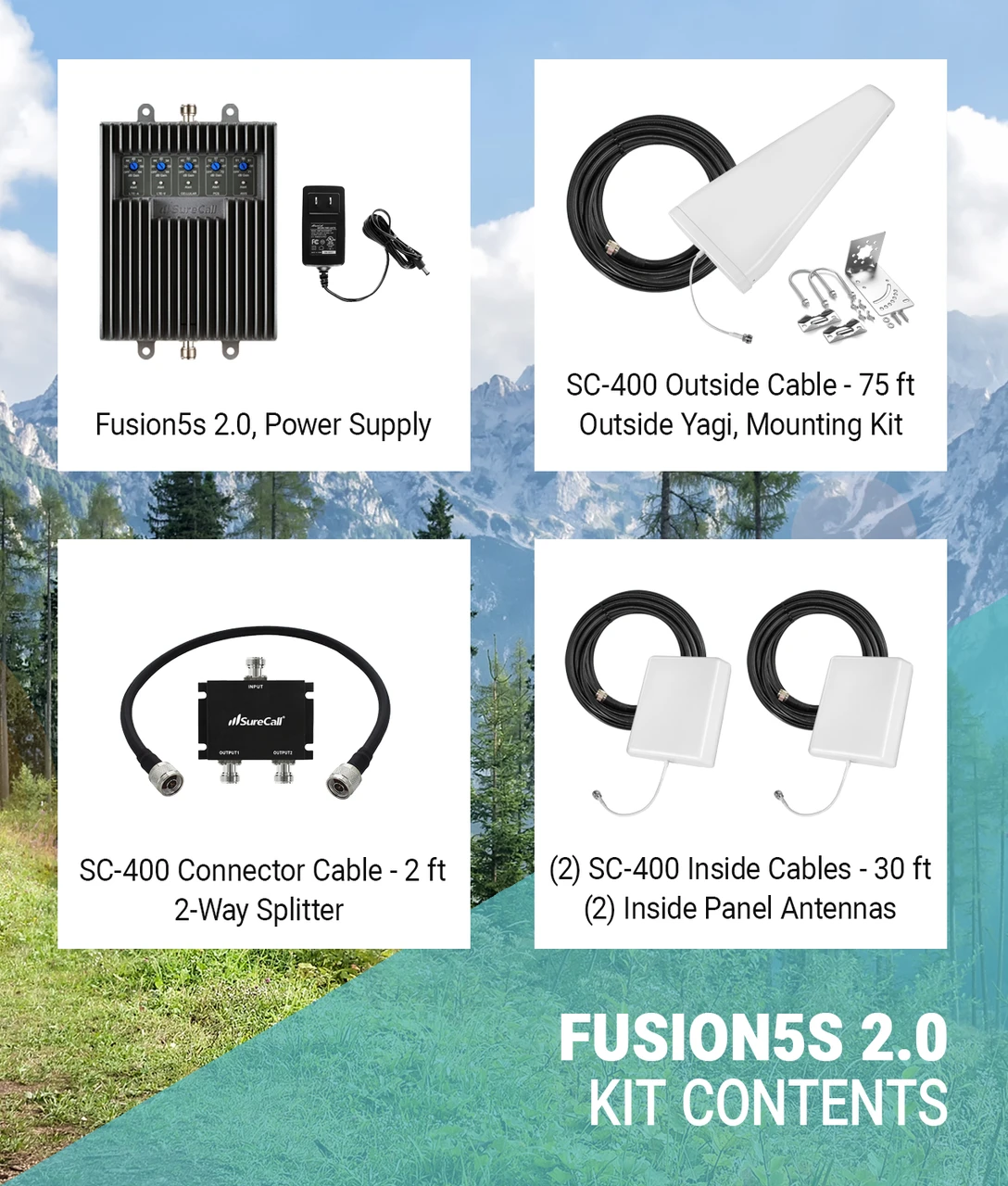
The SureCall Fusion5s 2.0 is an option to compare if you need support for 5G and 4G LTE service for voice, text, and data. It is listed as compatible with all major U.S. and Canadian carriers, with a maximum gain of 72 dB. Check that its carrier support and specifications fit your needs before choosing it.
Best for Shoppers comparing listed carrier compatibility and supported service.
| Maximum gain | +72 dB max |
|---|---|
| Supported service | 5G and 4G/LTE for voice, text, and data |
| Carrier compatibility | Works with all major US and Canadian carriers |
Pros
- Maximum gain is 72 dB.
- The booster case is metal.
- Signal readout uses LED lights.
Cons
- The booster case is metal, so account for the unit when planning its placement.
Buy if You want a booster listed for 5G and 4G LTE voice, text, and data on major U.S. and Canadian carriers.
Skip if You need a published coverage estimate before choosing.
Sources: Product source
4. CEL-FI QUATRA EVO Another Option
The CEL-FI QUATRA EVO is an option for shoppers comparing its published frequency bands and planning for the listed main-unit size and weight. Its frequency bands are 1, 3, 5, 7, 8, 20, 26, 28, and 40; the main unit measures 18.1 by 11.0 by 3.5 inches and weighs 19.4 pounds. Compare the listed bands with the service and location you need, and consider the unit’s dimensions when planning your setup.
Best for Shoppers who need to compare a documented multi-band option and have space for its listed main unit.
| Frequency bands | 1/3/5/7/8/20/26/28/40 |
|---|---|
| Main unit dimensions | 18.1 x 11.0 x 3.5 in |
| Main unit weight | 19.4 lbs (8.80 kg) |
Pros
- Published frequency-band list helps buyers compare band requirements.
- Main-unit dimensions and weight can help with placement planning.
- A multi-band option for shoppers whose requirements match its listed bands.
Cons
- The main unit weighs 19.4 pounds and measures 18.1 by 11.0 by 3.5 inches, so plan for its size and weight.
Buy if You want to evaluate the published frequency bands and main-unit dimensions against your requirements.
Skip if You need to choose primarily by a particular coverage figure or installation configuration.
Sources: Product source
How did we choose these recommendations?
- Compared published specifications for coverage, maximum gain, supported service, frequency bands, and physical configuration where those details were documented.
- Considered documented antenna arrangements and physical specifications when those details were available.
- Matched each recommendation to a defined home use, such as broad household coverage, rural reception, or a compact home setup, rather than treating one configuration as suitable for every property.
- Used published coverage estimates with their stated signal conditions in mind; coverage depends on outside signal strength and may vary inside a particular home.
We researched and compared published product specifications, documented features, and the sources linked beside each pick.
What should you look for when choosing home cell phone booster?
Check the signal outside first
A booster depends on cellular signal reaching its outdoor antenna. Check reception in likely mounting locations rather than relying only on the phone’s performance indoors. The Flare 3.0 lists coverage up to 2,500 square feet with strong outside signal. If outdoor signal is weak, plan for a smaller indoor coverage area than that estimate suggests.
Match the coverage estimate to your home
Compare the rooms you need to serve with each published coverage figure and its conditions. The Home Complete lists up to 7,500 square feet, while the Flare 3.0 lists up to 2,500 square feet with strong outside signal. These figures are not guarantees for an individual building; signal strength and building materials influence indoor results.
Choose an antenna arrangement you can install
Consider whether you can mount a directional outdoor antenna. The Flare 3.0 pairs a directional outdoor antenna with one omnidirectional inside antenna. Review the manufacturer’s installation guidance and equipment placement needs before choosing a system.
Confirm carrier and network support
Check that the booster supports the carrier and cellular service you rely on. The listed products vary in how their compatibility is described: the Home Complete supports all U.S. carriers, and the Fusion5s 2.0 is listed for major U.S. and Canadian carriers. For other networks, verify compatibility before purchase rather than inferring it from a band list.
Plan placement and follow requirements
Before buying, consider where the booster and antennas can be positioned and whether the product’s installation instructions fit your home. Check applicable provider requirements and follow the specific manufacturer instructions for the system you choose.
What is the best home cell phone booster for most households?
The weBoost Home Complete is a clear fit for a household seeking coverage across multiple rooms. Its published figure is up to 7,500 square feet, and it supports all U.S. carriers and 4G LTE and 5G networks. Those facts make it a useful starting point for homes where multiple people use different carriers.
That coverage figure is not a promise that every home will receive service throughout the stated area. The system depends on an available outdoor signal, and weak outside signal can limit indoor coverage. A booster amplifies available cellular signal rather than creating one where none exists.
For a smaller home, the SureCall Flare 3.0 is a narrower alternative, with published coverage up to 2,500 square feet under strong outside-signal conditions. The Fusion5s 2.0 is another option to compare, with a listed maximum gain of 72 dB and support for 5G and 4G LTE service for voice, text, and data. The best fit comes down to the signal at the antenna location, the space to cover, and the installation you can accommodate.
How much coverage should a home cell phone booster provide?
Start with the rooms where calls, texts, or cellular data are unreliable, then compare those needs with each product’s published coverage guidance. The weBoost Home Complete lists up to 7,500 square feet. SureCall lists the Flare 3.0 at up to 2,500 square feet with strong outside signal.
Coverage estimates are not interchangeable with guaranteed results. Signal strength outdoors, building materials, antenna placement, and the layout of the home can all affect what reaches indoor devices. A manufacturer’s stated coverage figure is best read as a conditional estimate, not a measurement of what your own rooms will receive.
Before choosing, look for usable cellular signal at a potential outdoor antenna location. If outside reception is weak, an advertised large coverage area may not translate to the same indoor footprint. If the problem is limited to one room, a system designed for extensive household coverage could be more than necessary. Match the product to both your outside signal and the areas you actually want to serve.
FAQ
Can a home cell phone booster create service where there is no signal?
No. A booster amplifies an available outside cellular signal; it does not create coverage where no signal is available. Check for usable reception at a potential outdoor antenna location before choosing a system.
Does a larger coverage estimate guarantee service in every room?
No. Coverage figures are estimates, not guarantees. The Home Complete lists up to 7,500 square feet. Signal strength, building materials, and the home’s layout can affect indoor reception.
What should rural shoppers compare when choosing a booster?
The Fusion5s 2.0 is one option to compare: it is listed for 5G and 4G LTE voice, text, and data, with a maximum gain of 72 dB and compatibility with all major U.S. and Canadian carriers. Check that its listed support fits your needs.
Do these boosters support 5G?
The Home Complete supports 4G LTE and 5G networks, and the Flare 3.0 supports voice, text, 4G LTE, and 5G. The Fusion5s 2.0 is documented for 5G and 4G LTE service for voice, text, and data. Confirm that the relevant carrier and service are supported for your location.
Do I need to register a consumer signal booster?
Requirements can vary by provider and product. Check with your wireless provider and follow the instructions and requirements for the model you choose.
How should I choose between a directional and omnidirectional outdoor antenna?
A directional antenna is intended to focus toward a particular signal source. The Flare 3.0 includes a directional outdoor antenna and one omnidirectional inside antenna. Consider the conditions at your property and the product’s installation instructions before choosing a system.
Which home cell phone booster should you buy?
For most homes, start with the weBoost Home Complete. For another option, compare the SureCall Flare 3.0. Need the use-case pick? Consider the CEL-FI QUATRA EVO.
- Best Overall: weBoost Home Complete
- Alternative Pick: SureCall Flare 3.0
- Another Option: CEL-FI QUATRA EVO
When was this guide last updated?
- November 07, 2026: Editorial research prepared. Product specifications and source images reviewed.